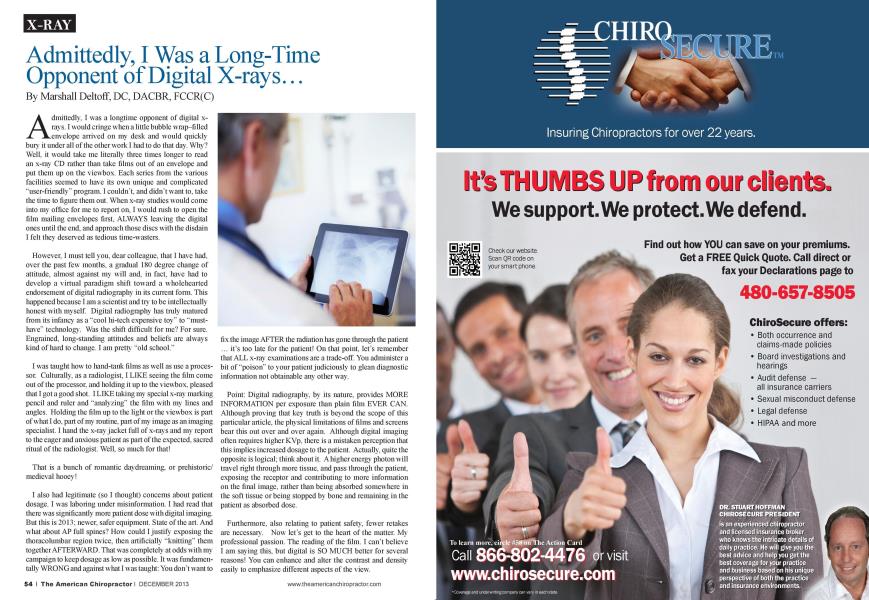
A dmittedly. I was a longtime opponent of digital x-rays. I would cringe when a little bubble wrap-filled envelope arrived on my desk and would quickly bun it under all of the other work I had to do that day. Why? Well, it would take me literally three times longer to read an x-ray CD rather than take films out of an envelope and put them up on the viewbox. Each scries from the various facilities seemed to have its own unique and complicated "user-friendly" program. I couldn't, and didn't want to. take the time to figure them out. When x-ray studies would come into my office for me to report on. I would rush to open the film mailing envelopes first. ALWAYS leaving the digital ones until the end. and approach those discs with the disdain I felt they deserved as tedious time-w asters. However. I must tell you. dear colleague, that I have had. over the past few months, a gradual 180 degree change of attitude, almost against my will and. in fact, have had to develop a virtual paradigm shift toward a wholehearted endorsement of digital radiography in its current form. This happened because I am a scientist and try to be intellectually honest with myself. Digital radiograph) has truly matured from its infancy as a "cool hi-tech expensive toy" to "must-havc" technology. Was the shift difficult for me? For sure. Engrained, long-standing attitudes and beliefs are always kind of hard to change. I am pretty "old school." I was taught how to hand-tank films as well as use a processor. Culturally, as a radiologist. I LIKE seeing the film come out of the processor, and holding it up to the viewbox. pleased that I got a good shot. I LIKE taking my special x-ray marking pencil and ruler and "analyzing" the film with my lines and angles. Holding the film up to the light or the viewbox is part of what I do. part of my routine, part of my image as an imaging specialist. I hand the x-ray jacket full of x-rays and my report to the eager and anxious patient as part of the expected, sacred ritual of the radiologist. Well, so much for that! Tliat is a bunch of romantic daydreaming, or prehistoric/ medieval hooey! I also had legitimate (so I thought) concerns about patient dosage. I was laboring under misinformation. I had read that there was significantly more patient dose with digital imaging. But this is 2013: newer, safer equipment. State of the art. And what about AP full spines? How could I justify exposing the thoracolumbar region twice, then artificially "knitting" them together AFTERWARD. That was completely at odds with my campaign to keep dosage as low as possible. It was fundamentally WRONG and against what I was taught: You don't want to fix the image AFTER the radiation has gone through the patient ... it's too late for the patient! On that point, lets remember tliat ALL x-ray examinations arc a trade-off. You administer a bit of "poison" to your patient judiciously to glean diagnostic infonnation not obtainable any other way. Point: Digital radiography, by its nature, provides MORE INFORMATION per exposure than plain film EVER CAN. Although proving that key truth is beyond the scope of this particular article, the physical limitations of films and screens bear this out over and over again. Although digital imaging often requires higher KVp. there is a mistaken perception that this implies increased dosage to the patient. Actually, quite the opposite is logical: think about it. A higher energy photon will travel right through more tissue, and pass through the patient, exposing the receptor and contributing to more infonnation on the final image, rather than being absorbed somewhere in the soft tissue or being stopped by bone and remaining in the patient as absorbed dose. Furthermore, also relating to patient safety, fewer retakes arc necessary. Now let's get to the heart of the matter. My professional passion. The reading of the film. I can't believe I am saying this, but digital is SO MUCH better for several reasons! You can enhance and alter the contrast and density easily to emphasize different aspects of the view. The new annotation software takes x-ray marking and patient education to a level unachievable with pencil, ruler, and protractor. Precision and accuracy in measurement skyrockets: some programs allow me to measure to 1/10 of a millimeter! The aforementioned increase in information obtained with digital x-rays is clearly in the patient's best interest insofar as cost/ benefit ratio of exposing someone to x-radiation. Its also more helpful for the doctor to have more diagnostic information for the same radiation cost. A win-win no-brainer! And. finally, an important part of the paradigm sliift: in fact, the essence of my paradigm shift... whenever I look at a digital film, whether of an 80-ycar-old or a 22-ycar-old. the skeleton looks osteoporotic! It was so clear to me that digital was inferior because it makes everyone look artificially osteoporotic. WRONG!!! Actually, digital imaging more accurately depicts the proper and authentic trabccular pattern of the imaged bones. It provides more clarity to the final picture—THIS is a far tmcr picture of the skeleton we arc examining. So why did I think that all digital films looked ostcoporotic? Because the inherent LIMITATIONS of the film/screen technology blurred the trabecu-lation. artificially (read: artifactually) making all bones look somewhat whiter. Proof that plain-film x-ray, by its physical limitations, lias historically and culturally forced us to accept, as normal, an inferior depiction of the reality of the skeleton being imaged. That's not a bad thing; that WAS the accepted standard of the day: that WAS the best we had. I said WAS. We have better now. and you and your patients deserve it. Throw out the black-and-white TV. the 8-track. and the outhouse. We have indoor plumbing now. So that is my paradigm shift. I am getting more comfortable with it. Arc you ready to open your mind too? I Dr. Marshall Deltoff is a specialist in diagnostic imaging with over 25 years of academic and clinical experience. He has taught all aspects ofundergraduate radiology at CMCC, where he also chaired the radiol- ogy residency program and initiated the radiology curriculum at the Universite du Quebec a Trois-Rivieres. The co-author of The Portable Skeletal X-Ray Library, Dr. Deltoff serves as an Advisor to ImaSight. Visit ImaSightChiro.com to view additional blog articles from the X-Files.