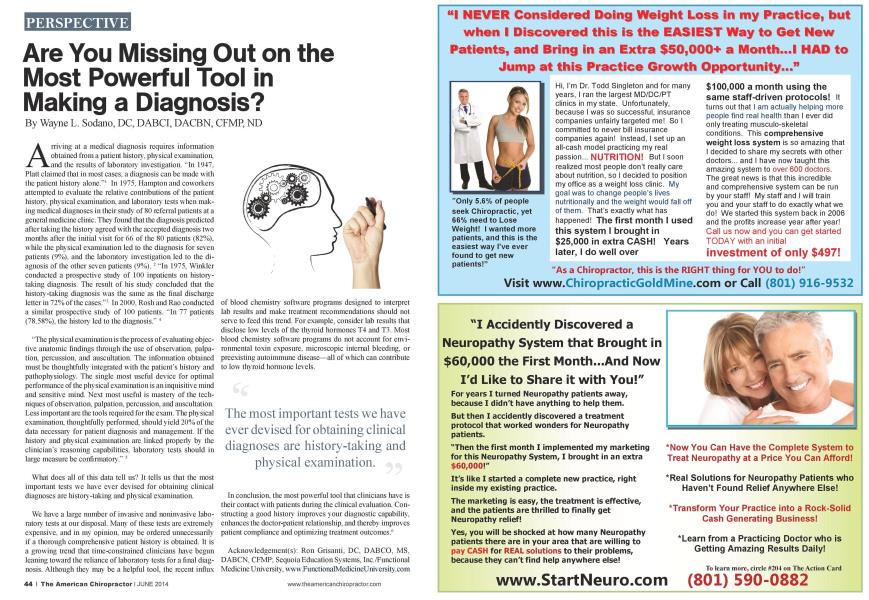
Arriving at a medical diagnosis requires information obtained from a patient history, physical examination, and the results of laboratory investigation. "In 1947. Platt claimed that in most cases, a diagnosis can be made with the patient history alone."1 In 1975. Hampton and coworkers attempted to evaluate the relative contributions of the patient history, physical examination, and laboratory tests when making medical diagnoses in their study of 80 referral patients at a general medicine clinic. They found that the diagnosis predicted after taking the history agreed with the accepted diagnosis two months after the initial visit for 66 of the 80 patients (82%). while the physical examination led to the diagnosis for seven patients (9%). and the laboratory investigation led to the diagnosis of the other seven patients (9%). - "In 1975. Winkler conducted a prospective study of 100 inpaticnts on history-taking diagnosis. The result of his study concluded that the history-taking diagnosis was the same as the final discharge letter in 72% of the cases."' In 2000. Rosh and Rao conducted a similar prospective study of 100 patients. "In 77 patients (78.58%). the history led to the diagnosis." 4 "The physical examination is the process of evaluating objective anatomic findings through the use of observation, palpation, percussion, and auscultation. The information obtained must be thoughtfully integrated with the patient's history and pathophysiology. The single most useful device for optimal performance of the physical examination is an inquisitive mind and sensitive mind. Next most useful is mastery of the techniques of observation, palpation, percussion, and auscultation. Less important arc the tools required for the exam. The physical examination, thoughtfully performed, should yield 20% of the data necessary for patient diagnosis and management. If the history and physical examination arc linked properly by the clinician's reasoning capabilities, laboratory tests should in large measure be confirmatory." 5 What does all of this data tell us? It tells us that the most important tests we have ever devised for obtaining clinical diagnoses are history-taking and physical examination. We have a large number of invasive and noninvasivc laboratory tests at our disposal. Many of these tests arc extremely expensive, and in my opinion, may be ordered unnecessarily if a thorough comprehensive patient history is obtained. It is a growing trend that time-constrained clinicians have begun leaning toward the reliance of laboratory tests for a final diagnosis. Although they may be a helpful tool, the recent influx of blood chemistry software programs designed to interpret lab results and make treatment recommendations should not serve to feed this trend. For example, consider lab results that disclose low levels of the thyroid hormones T4 and T3. Most blood chcniistn software programs do not account for environmental toxin exposure, microscopic internal bleeding, or preexisting autoimmune disease—all of which can contribute to low tin raid hormone levels. In conclusion, the most powerful tool that clinicians have is their contact with patients during the clinical evaluation. Constructing a good history improves your diagnostic capability, enhances the doctor-patient relationship, and thereby improves patient compliance and optimizing treatment outcomes.1' Acknowlcdgcment(s): Ron Grisanti. DC. DABCO. MS. DABCN. CFMP; Sequoia Education Systems. Inc./Functional Medicine Universitv.www.FunctionalMcdicineUnivcrsitv.com References Peterson MC. Holbrook JH. Von Hales DE. Smith NL. Stakcr LV ('onlrihiilions of the History. Physical Examination, and Laboratory investigation in .\ taking Medical Diagnoses. West JMed. 1992 Feb: 156:163-165. Ibid. Winklcr P. The Importance of History-taking Diagnosis of Inflammatory Rheumatic Disease: a Prospective Study of 100 Patient's. Dtsch Med Worchenschr. 1997 Sep 14:104(37):1301-6. Roshan M. Rao AP. A study on relative contributions of the history, physical examination and investigations in making medical diagnosis. J Assoc Physicians India. 2000 Aug:48(8):771-5 Campbell EW. Lynn CK. Clinical Methods: The History, Physical, and Laboratory Examinations. 3rd ed. Boston: Buttcnvorths: 1990. Chapter 4. Bensclcr IM. Do you believe in the power of clinical ex- amination? The answer must he yes' Sao Paulo Med J. 2003;121(6):223. Dr. Wayne Sodano has over 26 years of combined private practice and teaching experience in functional medicine under the paradigm of natural internal medicine. In addition to his IX'. he holds an XI). Diplomale board certification with the American Board of Chiropractic Internists and the American Clinical Board of Nutrition, and is a former instructor for the Diplomate program for the American Board of Chiropractic Internists. He currently leaches post doctorate continuing education training in functional medicine with Dr. Ron Grisanli at Functional Medicine University. Dr. Sodano and Dr. Grisanli are co-creators of www.FMlMgics.com. an on-line comprehensive patient history analysis software program.