Do You Know the Five Questions About Chiropractic You Have to Answer?
PRACTICE MANAGEMENT
Stuart Hoffman
Eighty percent of you reading this article have already scrolled down to read the five questions.* Did you? You won’t be able to find the five questions in this article because, for now, the five questions are not important. What is important is understanding the “why” of the five questions.*
As a successful practitioner for 34 years, having owned multiple clinics and now helping chiropractors protect their future for over 26 years, I see hugely successful doctors, many straggling doctors, and way too many doctors failing. Too many doctors believe that the key to success is to memorize, mimic, and repeat what a successful doctor does or says in his or her practice that also will make them successful. Unfortunately, rarely does that work.
It is never as shnple as “I’ll do what they do, say what they say.” Most successful doctors do and say what they do based on
“In business, you must answer the questions that your customers (patients) ask, otherwise they go to someone who can answer them. 5 5
their “why,” and if you don’t have the same “why” or understand tlie “why,” just memorizing what they say will never be as effective as having your own “why.” Let’s get back to the “why” of our five questions.
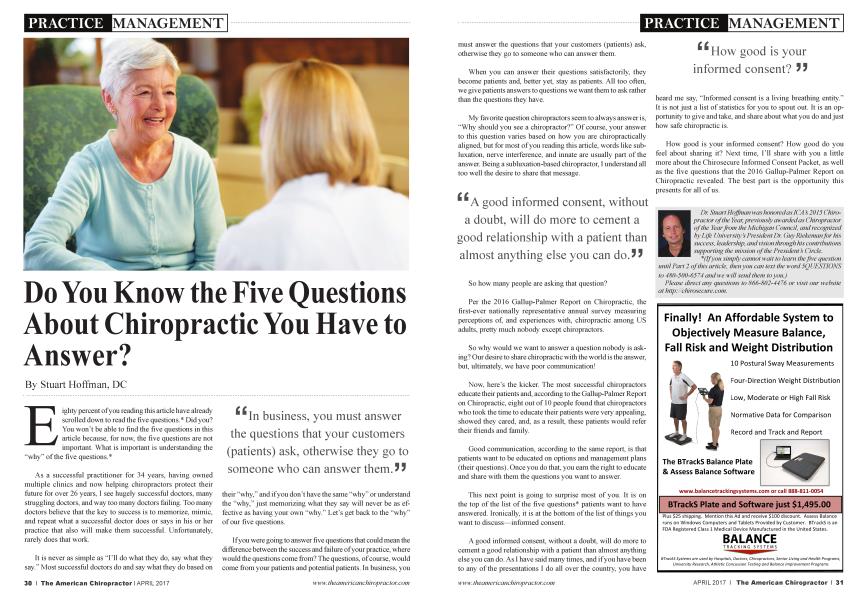
If you were going to answer five questions that could mean the difference between the success and failure of your practice, where would the questions come from? The questions, of course, would come from your patients and potential patients. In business, you
must answer the questions that your customers (patients) ask, otherwise they go to someone who can answer them.
When you can answer their questions satisfactorily, they become patients and, better yet, stay as patients. All too often, we give patients answers to questions we want them to ask rather than the questions they have.
My favorite question chiropractors seem to always answer is, “Why should you see a chiropractor?” Of course, your answer to this question varies based on how you are chiropractically aligned, but for most of you reading this article, words like subluxation, nerve interference, and innate are usually paid of the answer. Being a subluxation-based chiropractor, I understand all too well the desire to share that message.
^ A good informed consent, without a doubt, will do more to cement a good relationship with a patient than almost anything else you can do. 5 5
So how many people are asking that question?
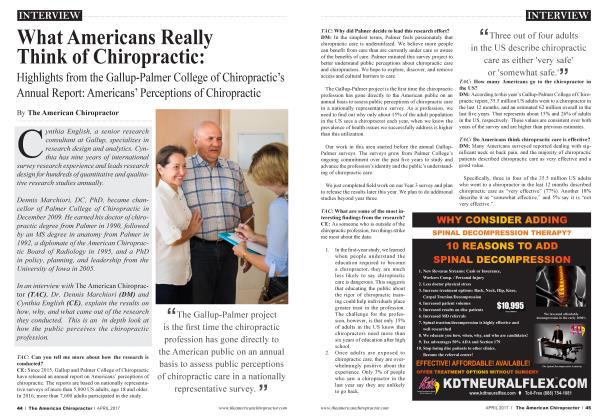
Per the 2016 Gallup-Palmer Report on Chiropractic, the first-ever nationally representative annual survey measuring perceptions of, and experiences with, chiropractic among US adults, pretty much nobody except chiropractors.
So why would we want to answer a question nobody is asking? Our desire to share chiropractic with the world is the answer, but, ultimately, we have poor communication!
Now, here’s the kicker. The most successful chiropractors educate their patients and, according to the Gallup-Palmer Report on Chiropractic, eight out of 10 people found that chiropractors who took the time to educate their patients were very appealing, showed they cared, and, as a result, these patients would refer their friends and family.
Good communication, according to the same report, is that patients want to be educated on options and management plans (their questions). Once you do that, you earn the right to educate and share with them the questions you want to answer.
This next point is going to surprise most of you. It is on the top of the list of the five questions* patients want to have answered. Ironically, it is at the bottom of the list of things you want to discuss—informed consent.
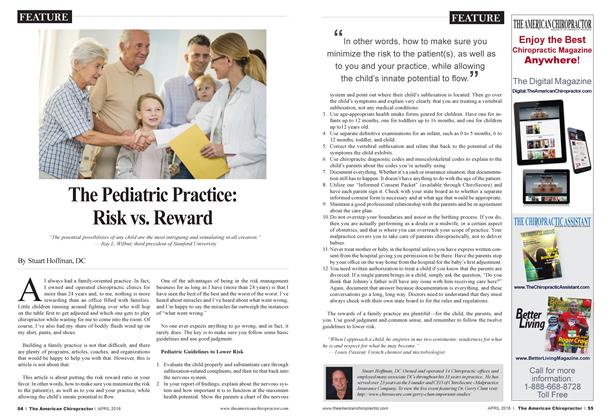
A good informed consent, without a doubt, will do more to cement a good relationship with a patient than almost anything else you can do. As I have said many times, and if you have been to any of the presentations I do all over the country, you have
^How good is your informed consent? 55
heard me say, “Informed consent is a living breathing entity.” It is not just a list of statistics for you to spout out. It is an opportunity to give and take, and share about what you do and just how safe chiropractic is.
How good is your informed consent? How good do you feel about sharing it? Next time, I’ll share with you a little more about the Chirosecure Informed Consent Packet, as well as the five questions that the 2016 Gallup-Palmer Report on Chiropractic revealed. The best part is the opportunity this presents for all of us.
nDr. Stuart Hoffman was honored as ICA s 2015 Chiropractor of the Year, previously awarded as Chiropractor of the Year from the Michigan Council, and recognized by Life University’s President Dr. Guy Riekeman for his success, leadership, and vision through his contributions supporting the mission of the President ’s Circle.
* (Ifyou simply cannot wait to learn the five question until Part 2 of this article, then you can text the word 50UESTI0NS to 480-500-6574 and we will send them to you.)
Please direct any questions to 866-802-4476 or visit our website at http://chirosecure. com.