Concussion Recovery Goes Mobile
INTERVIEW
Interview with Dr. Sanjeev Sharma
The American Chiropractor
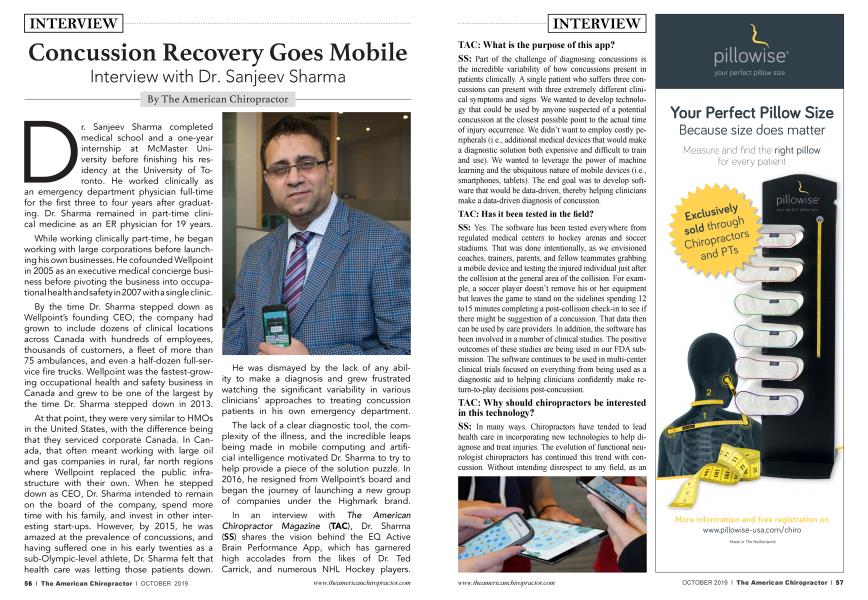
Dr. Sanjeev Sharma completed medical school and a one-year internship at McMaster University before finishing his residency at the University of Toronto. He worked clinically as an emergency department physician full-time for the first three to four years after graduating. Dr. Sharma remained in part-time clinical medicine as an ER physician for 19 years.
While working clinically part-time, he began working with large corporations before launching his own businesses. He cofounded Wellpoint in 2005 as an executive medical concierge business before pivoting the business into occupational health and safety in 2007 with a single clinic.
By the time Dr. Sharma stepped down as Wellpoint's founding CEO, the company had grown to include dozens of clinical locations across Canada with hundreds of employees, thousands of customers, a fleet of more than 75 ambulances, and even a half-dozen full-service fire trucks. Wellpoint was the fastest-growing occupational health and safety business in Canada and grew to be one of the largest by the time Dr. Sharma stepped down in 2013.
At that point, they were very similar to HMOs in the United States, with the difference being that they serviced corporate Canada. In Canada, that often meant working with large oil and gas companies in rural, far north regions where Wellpoint replaced the public infrastructure with their own. When he stepped down as CEO, Dr. Sharma intended to remain on the board of the company, spend more time with his family, and invest in other interesting start-ups. However, by 2015, he was amazed at the prevalence of concussions, and having suffered one in his early twenties as a sub-Olympic-level athlete, Dr. Sharma felt that health care was letting those patients down.
He was dismayed by the lack of any ability to make a diagnosis and grew frustrated watching the significant variability in various clinicians' approaches to treating concussion patients in his own emergency department.
The lack of a clear diagnostic tool, the complexity of the illness, and the incredible leaps being made in mobile computing and artificial intelligence motivated Dr. Sharma to try to help provide a piece of the solution puzzle. In 2016, he resigned from Wellpoint's board and began the journey of launching a new group of companies under the Highmark brand.
In an interview with The American Chiropractor Magazine (TAC), Dr. Sharma (SS) shares the vision behind the EQ Active Brain Performance App, which has garnered high accolades from the likes of Dr. Ted Carrick, and numerous NHL Hockey players.
TAC: What is the purpose of this app?
SS: Part of the challenge of diagnosing concussions is the incredible variability of how concussions present in patients clinically. A single patient who suffers three concussions can present with three extremely different clinical symptoms and signs. We wanted to develop technology that could be used by anyone suspected of a potential concussion at the closest possible point to the actual time of injury occurrence. We didn't want to employ costly peripherals (i.e., additional medical devices that would make a diagnostic solution both expensive and difficult to train and use). We wanted to leverage the power of machine learning and the ubiquitous nature of mobile devices (i.e., smartphones, tablets). The end goal was to develop software that would be data-driven, thereby helping clinicians make a data-driven diagnosis of concussion.
TAC: Has it been tested in the field?
SS: Yes. The software has been tested everywhere from regulated medical centers to hockey arenas and soccer stadiums. That was done intentionally, as we envisioned coaches, trainers, parents, and fellow teammates grabbing a mobile device and testing the injured individual just after the collision at the general area of the collision. For example, a soccer player doesn't remove his or her equipment but leaves the game to stand on the sidelines spending 12 to 15 minutes completing a post-collision check-in to see if there might be suggestion of a concussion. That data then can be used by care providers. In addition, the software has been involved in a number of clinical studies. The positive outcomes of these studies are being used in our FDA submission. The software continues to be used in multi-center clinical trials focused on everything from being used as a diagnostic aid to helping clinicians confidently make retum-to-play decisions post-concussion.
TAC: Why should chiropractors be interested in this technology?
SS: In many ways. Chiropractors have tended to lead health care in incorporating new technologies to help diagnose and treat injuries. The evolution of functional neurologist chiropractors has continued this trend with concussion. Without intending disrespect to any field, as an ER physician following standard medical guidelines, I was telling patients to just sit in a dark room, which we now know is not very helpful. Meanwhile, functional neurologists, like Dr. Ted Carrick, were employing incredibly innovative approaches to diagnosing and treating patients who had suffered a concussion. That legacy of being trailblazers in bringing solid, cutting-edge medical technology to patients should be leveraged as chiropractors search for new ways to not only diagnose and treat their patients, but also begin to employ predictive analytics to understand which patients are at future risk for injury.
TAC: Have any chiropractors tested this? What are their thoughts?
SS: Chiropractors were definitely some of the clinical stakeholders we brought this technology to. Their response has been overwhelmingly positive and insightful. The fact that they can see how their patients are managing between visits gives them both more information and information that is impact rich. This combination has enabled chiropractors to further refine treatment protocols or understand more clearly where certain patients have plateaued in their improvement.
TAC: Where can chiropractors test this?
SS: They can download EQ Active Brain Performance from either the Apple App Store or Google Play, depending on the software they use on their mobile devices. The software is structured as six games, and, thus, clinicians have very little trouble learning how to use the software. When they are ready to move forward, our team equips them with the web dashboard, which is a comprehensive tool that allows clinicians to monitor the results of their patients' game tests.
To talk to Dr. Sanjeev Sharma, visit
highmark.tech or email at ceo@highmark.tech