The Large Intestine
ORGAN OF THE MONTH
Howard F. Loomis
Jr., DC
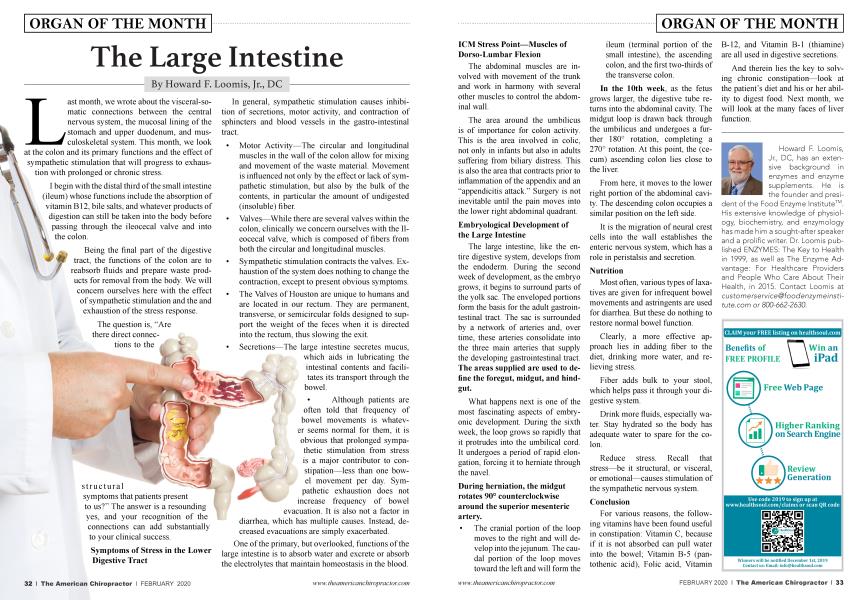
Last month, we wrote about the visceral-somatic connections between the central nervous system, the mucosal lining of the stomach and upper duodenum, and musculoskeletal system. This month, we look at the colon and its primary functions and the effect of sympathetic stimulation that will progress to exhaustion with prolonged or chronic stress.
I begin with the distal third of the small intestine (ileum) whose functions include the absorption of vitamin B12, bile salts, and whatever products of digestion can still be taken into the body before passing through the ileocecal valve and into the colon.
Being the final part of the digestive tract, the functions of the colon are to reabsorb fluids and prepare waste products for removal from the body. We will concern ourselves here with the effect of sympathetic stimulation and the and exhaustion of the stress response.
The question is, “Are there direct connections to the
structural symptoms that patients present to us?” The answer is a resounding yes, and your recognition of the connections can add substantially to your clinical success.
Symptoms of Stress in the Lower Digestive Tract
In general, sympathetic stimulation causes inhibition of secretions, motor activity, and contraction of sphincters and blood vessels in the gastro-intestinal tract.
• Motor Activity—The circular and longitudinal muscles in the wall of the colon allow for mixing and movement of the waste material. Movement is influenced not only by the effect or lack of sympathetic stimulation, but also by the bulk of the contents, in particular the amount of undigested (insoluble) fiber.
• Valves—While there are several valves within the colon, clinically we concern ourselves with the Ileocecal valve, which is composed of fibers from both the circular and longitudinal muscles.
• Sympathetic stimulation contracts the valves. Exhaustion of the system does nothing to change the contraction, except to present obvious symptoms.
• The Valves of Houston are unique to humans and are located in our rectum. They are permanent, transverse, or semicircular folds designed to support the weight of the feces when it is directed into the rectum, thus slowing the exit.
• Secretions—The large intestine secretes mucus,
which aids in lubricating the intestinal contents and facilitates its transport through the bowel.
• Although patients are often told that frequency of bowel movements is whatever seems normal for them, it is obvious that prolonged sympathetic stimulation from stress is a major contributor to constipation—less than one bowel movement per day. Sympathetic exhaustion does not increase frequency of bowel evacuation. It is also not a factor in diarrhea, which has multiple causes. Instead, decreased evacuations are simply exacerbated.
One of the primary, but overlooked, functions of the large intestine is to absorb water and excrete or absorb the electrolytes that maintain homeostasis in the blood.
ICM Stress Point—Muscles of Dorso-Lumbar Flexion
The abdominal muscles are involved with movement of the trunk and work in harmony with several other muscles to control the abdominal wall.
The area around the umbilicus is of importance for colon activity. This is the area involved in colic, not only in infants but also in adults suffering from biliary distress. This is also the area that contracts prior to inflammation of the appendix and an “appendicitis attack.” Surgery is not inevitable until the pain moves into the lower right abdominal quadrant.
Embryological Development of the Large Intestine
The large intestine, like the entire digestive system, develops from the endoderm. During the second week of development, as the embryo grows, it begins to surround parts of the yolk sac. The enveloped portions form the basis for the adult gastrointestinal tract. The sac is surrounded by a network of arteries and, over time, these arteries consolidate into the three main arteries that supply the developing gastrointestinal tract. The areas supplied are used to define the foregut, midgut, and hindgut.
What happens next is one of the most fascinating aspects of embryonic development. During the sixth week, the loop grows so rapidly that it protrudes into the umbilical cord. It undergoes a period of rapid elongation, forcing it to herniate through the navel.
During herniation, the midgut rotates 90° counterclockwise around the superior mesenteric artery.
• The cranial portion of the loop moves to the right and will develop into the jejunum. The caudal portion of the loop moves toward the left and will form the ileum (terminal portion of the small intestine), the ascending colon, and the first two-thirds of the transverse colon.
In the 10th week, as the fetus grows larger, the digestive tube returns into the abdominal cavity. The midgut loop is drawn back through the umbilicus and undergoes a further 180° rotation, completing a 270° rotation. At this point, the (cecum) ascending colon lies close to the liver.
From here, it moves to the lower right portion of the abdominal cavity. The descending colon occupies a similar position on the left side.
It is the migration of neural crest cells into the wall establishes the enteric nervous system, which has a role in peristalsis and secretion.
Nutrition
Most often, various types of laxatives are given for infrequent bowel movements and astringents are used for diarrhea. But these do nothing to restore normal bowel function.
Clearly, a more effective approach lies in adding fiber to the diet, drinking more water, and relieving stress.
Fiber adds bulk to your stool, which helps pass it through your digestive system.
Drink more fluids, especially water. Stay hydrated so the body has adequate water to spare for the colon.
Reduce stress. Recall that stress—be it structural, or visceral, or emotional—causes stimulation of the sympathetic nervous system.
Conclusion
For various reasons, the following vitamins have been found useful in constipation: Vitamin C, because if it is not absorbed can pull water into the bowel; Vitamin B-5 (pantothenic acid), Folic acid, Vitamin B-12, and Vitamin B-l (thiamine) are all used in digestive secretions.
And therein lies the key to solving chronic constipation—look at the patient’s diet and his or her ability to digest food. Next month, we wifi look at the many faces of liver function.
Howard F. Loomis, Jr., DC, has an extensive background in enzymes and enzyme supplements. He is the founder and president of the Food Enzyme Institute™. His extensive knowledge of physiology, biochemistry, and enzymology has made him a sought-after speaker and a prolific writer. Dr. Loomis published ENZYMES: The Key to Health in 1999, as well as The Enzyme Advantage: For Healthcare Providers and People Who Care About Their Health, in 2015. Contact Loomis at customerservice@food enzyme institute. com or 800-662-2630.