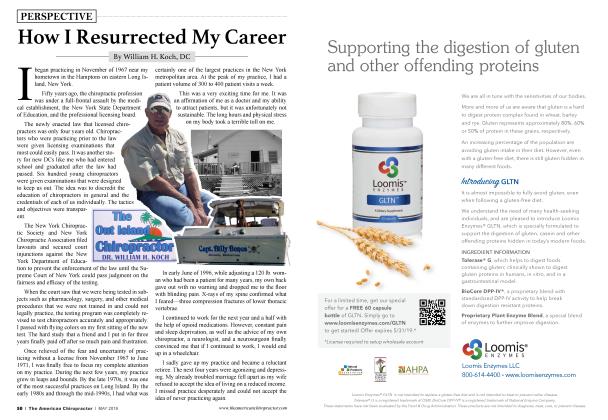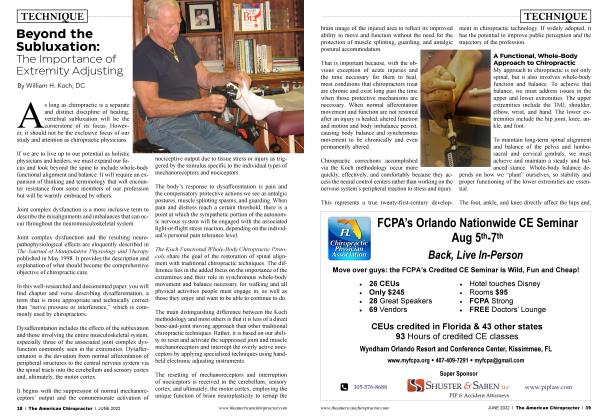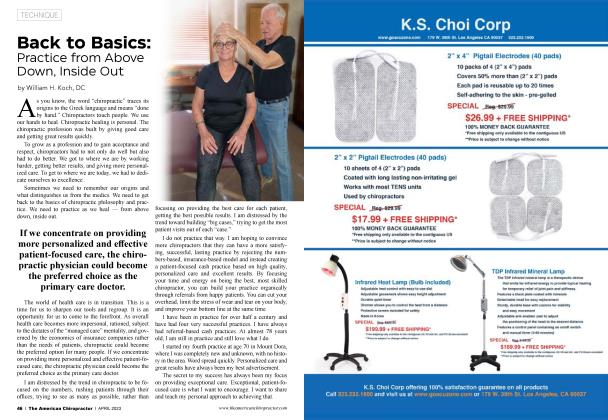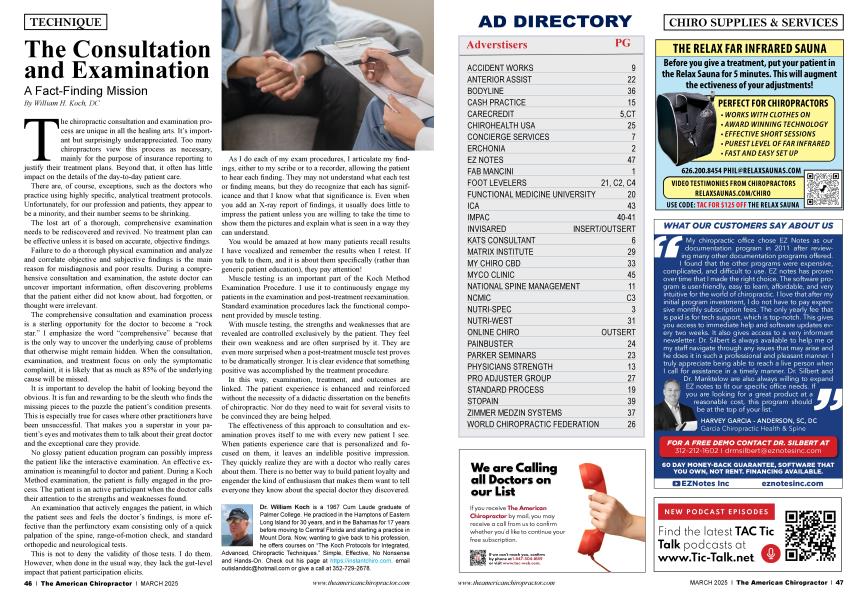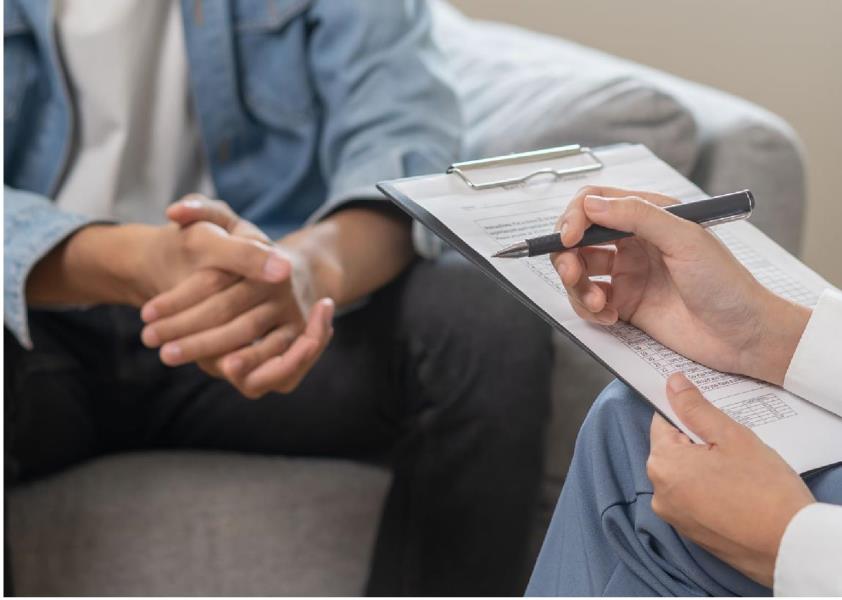
The chiropractic consultation and examination process are unique in all the healing arts. It’s important but surprisingly underappreciated. Too many chiropractors view this process as necessary, mainly for the purpose of insurance reporting to justify their treatment plans. Beyond that, it often has little impact on the details of the day-to-day patient care.
There are, of course, exceptions, such as the doctors who practice using highly specific, analytical treatment protocols. Unfortunately, for our profession and patients, they appear to be a minority, and their number seems to be shrinking.
The lost art of a thorough, comprehensive examination needs to be rediscovered and revived. No treatment plan can be effective unless it is based on accurate, objective findings.
Failure to do a thorough physical examination and analyze and correlate objective and subjective findings is the main reason for misdiagnosis and poor results. During a comprehensive consultation and examination, the astute doctor can uncover important information, often discovering problems that the patient either did not know about, had forgotten, or thought were irrelevant.
The comprehensive consultation and examination process is a sterling opportunity for the doctor to become a “rock star.” I emphasize the word “comprehensive” because that is the only way to uncover the underlying cause of problems that otherwise might remain hidden. When the consultation, examination, and treatment focus on only the symptomatic complaint, it is likely that as much as 85% of the underlying cause will be missed.
It is important to develop the habit of looking beyond the obvious. It is fun and rewarding to be the sleuth who finds the missing pieces to the puzzle the patient’s condition presents. This is especially true for cases where other practitioners have been unsuccessful. That makes you a superstar in your patient’s eyes and motivates them to talk about their great doctor and the exceptional care they provide.
No glossy patient education program can possibly impress the patient like the interactive examination. An effective examination is meaningful to doctor and patient. During a Koch Method examination, the patient is fully engaged in the process. The patient is an active participant when the doctor calls their attention to the strengths and weaknesses found.
An examination that actively engages the patient, in which the patient sees and feels the doctor’s findings, is more effective than the perfunctory exam consisting only of a quick palpation of the spine, range-of-motion check, and standard orthopedic and neurological tests.
This is not to deny the validity of those tests. I do them. However, when done in the usual way, they lack the gut-level impact that patient participation elicits.
As I do each of my exam procedures, I articulate my findings, either to my scribe or to a recorder, allowing the patient to hear each finding. They may not understand what each test or finding means, but they do recognize that each has significance and that I know what that significance is. Even when you add an X-ray report of findings, it usually does little to impress the patient unless you are willing to take the time to show them the pictures and explain what is seen in a way they can understand.
You would be amazed at how many patients recall results I have vocalized and remember the results when I retest. If you talk to them, and it is about them specifically (rather than generic patient education), they pay attention!
Muscle testing is an important part of the Koch Method Examination Procedure. I use it to continuously engage my patients in the examination and post-treatment reexamination. Standard examination procedures lack the functional component provided by muscle testing.
With muscle testing, the strengths and weaknesses that are revealed are controlled exclusively by the patient. They feel their own weakness and are often surprised by it. They are even more surprised when a post-treatment muscle test proves to be dramatically stronger. It is clear evidence that something positive was accomplished by the treatment procedure.
In this way, examination, treatment, and outcomes are linked. The patient experience is enhanced and reinforced without the necessity of a didactic dissertation on the benefits of chiropractic. Nor do they need to wait for several visits to be convinced they are being helped.
The effectiveness of this approach to consultation and examination proves itself to me with every new patient I see. When patients experience care that is personalized and focused on them, it leaves an indelible positive impression. They quickly realize they are with a doctor who really cares about them. There is no better way to build patient loyalty and engender the kind of enthusiasm that makes them want to tell everyone they know about the special doctor they discovered.
Dr. William Koch is a 1967 Cum Laude graduate of Palmer College. He practiced in the Hamptons of Eastern Long Island for 30 years, and in the Bahamas for 17 years before moving to Central Florida and starting a practice in Mount Dora. Now, wanting to give back to his profession, he offers courses on “The Koch Protocols for Integrated, Advanced, Chiropractic Techniques.” Simple, Effective, No Nonsense and Hands-On. Check out his page at https://instantchiro.com, email outislanddc@hotmail.com or give a call at 352-729-2678.