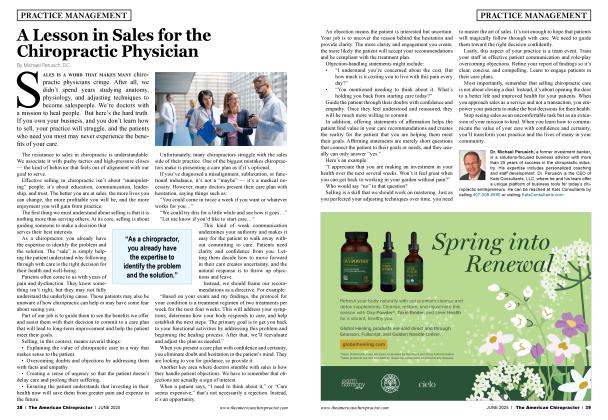
In chiropractic practice, your report of findings (ROF) is one of the most critical moments of patient conversion. Several things happen in the high-impact ROF conversation. In fact, it’s where trust is built, care is accepted, and value is established.
However, far too often chiropractors tend to sabotage their own authority. It doesn’t happen through poor diagnostics or bad recommendations, but via the use of weak language.
Your words either establish credibility or erode confidence. Earning a patient’s trust and respect is essential, so how you communicate is just as important as what you communicate.
Let’s look at three ways your vocabulary may be quietly killing your authority and what to say instead. The three mistakes include:
1. Creating uncertainty with your communication.
2. Asking the patient for permission to lead them.
3. The use of minimizing words in the ROF.
Let’s unpack each of these authority-destroying maneuvers in more detail.
First, you must avoid uncertain language. Some commonly used phrases may sound like you are trying to be humble, but instead, they create uncertainty. For example:
• “I think you might... ”
• “It could be...”
• “You may want to try... ”
Patients are looking for leadership, not speculation. When you sound unsure, patients assume your care recommendations are optional, not essential.
Instead, use authoritative certainty:
• “Your exam shows... ”
• “This is what’s causing your pain.”
• “Here’s the plan to correct your condition.”
Certainty communicates confidence, and confidence creates trust. It shows patients you’re not guessing, and they will feel guided by your expertise through their chiropractic journey.
Second, stop asking for permission to lead your patient. Too many chiropractors fall into the trap of permission-seeking phrases, such as:
• “Would you like to start care today?”
• “Do you want to come back next week?”
• “Would you be interested in trying chiropractic?”
This language puts the patient in charge of their clinical outcomes. It’s your job to lead the process, so shift your tone to one of assumptive authority. For example:
• “We’ll begin your first adjustment today.”
• “Your next visit will be in two days to start the correction process.”
• “This is the care plan that will get you the best results.”
Patients follow clarity. When you confidently prescribe care, they sense direction and expertise.
Lastly, eliminate words that minimize your care and your recommended plan. Words such as “just,” “a little,” “hopefully,” or “try” instantly shrink your authority. Here’s an example:
• “We’ll just do a few adjustments and see if you get any results.”
For the patient, that translates to, “This probably won’t work.”
Every word either builds up or breaks down your authority, so be intentional with your word choices. Replace minimizing words with ones that project confidence and purpose, such as:
• “We’ll begin your corrective care today and monitor your progress closely.”
Frame your words like a leader so that patients walk out of your ROF thinking, “That doctor knows exactly what’s going on and how to fix it.” Try this framework with your next ROF:
1. State the finding: “Your exam shows misalignment at C5 causing nerve interference.”
2. State the consequence: “That’s why you’re experiencing headaches.”
3. State the solution: “We’ll begin a corrective care plan of three visits per week for four weeks.”
4. State the result: “You’ll start to notice your headaches reduce as your nervous system begins to function better.”
Be clear. Be confident. Be compassionate.
You don’t need to sound arrogant; instead, sound certain. Patients aren’t buying a product; they’re buying confidence in your leadership and belief in your process.
If your ROF sounds like a suggestion, patients will treat your recommendations as being nonessential. However, when your words carry conviction, patients will gladly follow your direction, and they will do so confidently for the long term.
Remember, authority begins with how you speak.

Dr. Michael Perusich, a former investment banker, is a solutions-focused business advisor with more than 25 years of success in the chiropractic industry. His expertise includes personalized coaching and staff development. Dr. Perusich is the CEO of Kats Consultants, LLC., where he and his team offer a unique platform of business tools for today’s chiropractic entrepreneur. He can be reached at Kats Consultants 407-308-5590, or at Katsconsultants.com.