Have You Been Diagnosed Without Your Knowledge?
PERSPECTIVE
Tomas McFie
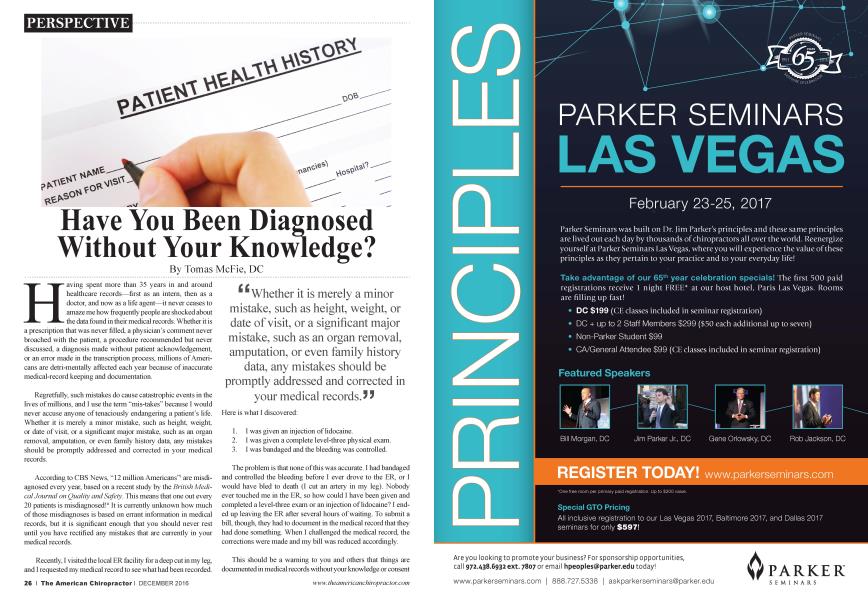
Having spent more than 35 years in and around healthcare records—first as an intern, then as a doctor, and now as a life agent—it never ceases to amaze me how frequently people are shocked about the data found in their medical records. Whether it is a prescription that was never filled, a physician’s comment never broached with the patient, a procedure recommended but never discussed, a diagnosis made without patient acknowledgement, or an error made in the transcription process, millions of Americans are detri-mentally affected each year because of inaccurate medical-record keeping and documentation.
Regretfully, such mistakes do cause catastrophic events in the lives of millions, and I use the term “mis-takes” because I would never accuse anyone of tenaciously endangering a patient’s life. Whether it is merely a minor mistake, such as height, weight, or date of visit, or a significant major mistake, such as an organ removal, amputation, or even family history data, any mistakes should be promptly addressed and corrected in your medical records.
According to CBS News, “12 million Americans”1 aie misdiagnosed every year, based on a recent study by the British Medical Journal on Quality and Safety. This means that one out every 20 patients is misdiagnosed!11 It is currently unknown how much of those misdiagnoses is based on errant information in medical records, but it is significant enough that you should never rest until you have rectified any mistakes that aie currently hi your medical records.
Recently, I visited the local ER facility for a deep cut in my leg, and I requested my medical record to see what had been recorded.
^Whether it is merely a minor mistake, such as height, weight, or date of visit, or a significant major mistake, such as an organ removal, amputation, or even family history data, any mistakes should be promptly addressed and corrected in your medical records. 5 5
Here is what I discovered:
1. I was given an injection of lidocaine.
2. I was given a complete level-three physical exam.
3. I was bandaged and the bleeding was controlled.
The problem is that none of this was accurate. I had bandaged and controlled the bleeding before I ever drove to the ER, or I would have bled to death (I cut an artery in my leg). Nobody ever touched me in the ER, so how could I have been given and completed a level-three exam or an injection of lidocaine? I ended up leaving the ER after several hours of waiting. To submit a bill, though, they had to document in the medical record that they had done something. When I challenged the medical record, the corrections were made and my bill was reduced accordingly.
This should be a warning to you and others that things aie documented in medical records without your knowledge or consent
more frequently than you would like to contemplate, especially if there is a third-party payer involved. Yes, we all want to trust our doctor and we all love our care providers, but they are human, and humans make mistakes. So never believe your medical records aie accurate until you review them yourself. Then don’t rest until they aie accurate.
Here aie some reasons why:
1. It could save your life.
2. It could save you money.
3. It could keep you from being denied life insurance coverage.
Yes, medical-record mistakes can be life threatening, but even if they are not life threatening, more often than not they aie detrimental to your wallet and your ability to get the life insurance coverage you deserve and need. My medical record, once corrected, saved me nearly $1,000. We’ve had clients save money on premiums by having their medical records corrected, and some have gone from a receiving a denial from the life insurance company to getting full coverage.
You see, your medical-records aie a third-party witness either for you or against you, especially if there are ever any legal questions about your health care. So it is imperative that you know what has been documented in that record because it might not be in your best interest for it to be documented the way it was.
By the way, don’t think for a minute that the Health Informa-
tion Portability and Accountability Act (HIPAA) does anything to prevent such mistakes from happening or protect you if they do. All HIPPA did was provide insurance carriers and government facilities the ability to collect the information they needed to advance the Patient Protection and Affordability Care Act (ACA). Of course, we all know now how effective the ACA is with a nearly 50% of the co-ops failing and even more of them subject to failure)'
it is not unusual for people applying for life insurance to find out for the first time about what then medical records contain. However, it’s not recommended, nor should it be, that you should apply for insurance coverage to make sure your medical records aie 100% conect. Simply ask for copies of your medical records each time you visit your medical provider. If you don’t recognize or understand what is documented in your medical records, then ask and persist until you aie comfortable with it because this is about you. It’s your life, your money, and your health. Besides, if you don’t do this, nobody will, and that could be devastating.
References
/. http://www. cbsnews. com hews/ 12-million-americans-misdiagnosed-each-year-study-says/ it.Ibid
Hi. http://www. heritage, org/research/commentary/2016/8/whyobamacare-co-ops-are-failing-at-a-rate-of-nearly-50-percent iv.http ://daily si gnal.com/2016/07/26/16-obamacare-co-opscollapsed-heres-how-the-rest-are-faring/
Dr. Tomas McFie is the founder of Life Benefits (www.life-benefits.com) and author of multiple books including “Retirement Curveball. ”